

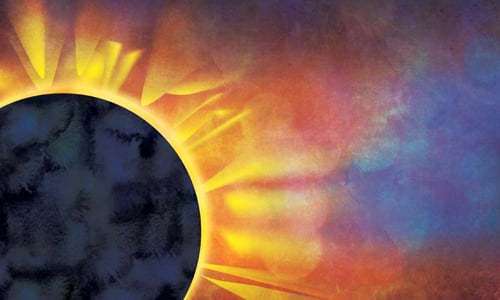
Eclipses: Fate and Freedom
On the Verse, “Let there be luminaries… and they shall serve as signs…”1 Rashi quotes the statement of our Sages:2 “When the luminaries are stricken it is an ill omen for the world, as in the verse3 ‘Be not dismayed at the signs of heaven, etc.’ But when you comply with the will of G‑d, you need not worry about punishment.”
Regarding the cause of eclipses the Talmud says,4 “On account of four things the sun is stricken: if the head of the rabbinical court dies and is not properly eulogized, etc. On account of four things the luminaries are smitten: on account of writers of forged documents, etc.” In other words, eclipses are related to people’s actions.
There is a famous question: The fact that the ‘luminaries are stricken’, i.e., that the sun and the moon become eclipsed, is a matter fixed in the nature of the cosmos, occurring at set intervals. In fact, one can even calculate in advance when it will occur. So how can we say that it happens as a result of human failings when it is really an unavoidable fact of nature?5
Over the course of time, certain people have used this “question” as “proof” that not everything the Sages said is correct.6 Thus, they excused and justified their own behavior, i.e., their decision not to fulfill Torah and Mitzvot.
The truth is, however, that one’s lack of Torah observance is not really because of his “intellectual questions”; it is rather because of the “appetite” of his emotions. The questions are no more than excuses to justify his improper behavior. That is why he can be comforted even with such a “question” that can be completely dispelled with even a little thought.
To preface:
It is well known that in Mishnaic and Talmudic times, the non-Jewish sages already knew the calculations to predict solar and lunar eclipses. Anyone who knows Jewish history (from the narratives in the teachings of our Sages, and — in greater detail — from the history texts of that era) knows that the non-Jewish scholars were in close contact with the Jewish Sages about matters of philosophy and science. They even traveled to meet each other and debate about various areas of knowledge,7 including astronomy.8
And even for those who are obstinate and unwilling to admit that the Jewish sages had a comprehensive knowledge of science9 and astronomy10 and that it was through them that this knowledge came to the non-Jews,11 it is nevertheless certain — completely beyond contention — that at the time when non-Jewish scholars knew about solar and lunar eclipses, our Sages knew as well,12 through the above-mentioned contact. This is especially true regarding astronomy, as the Sages had a particular interest in knowledge that impacts upon the Mitzvah of setting the Jewish calendar.13
It is therefore apparent that our Sages’ statement — that eclipses are an ill omen, and that they come because of specific misdeeds, etc. — cannot be contradictory to the necessity of eclipses according to the laws of nature.
Theoretically, one could explain14 that the statement that “eclipses are an ill omen, etc.” does not refer to the occurrence of the eclipses themselves, but rather to the fact that the person has seen one. Since the point of G‑d exhibiting an “ill omen” would be so that the people should return to Him,15 they must obviously be able to see the sign.
Accepting this premise would answer our original question: All that is required by the laws of nature is the eclipse itself. Nature does not require that we be able to see the eclipse, since there could be clouds, etc., which conceal the eclipse.
This detail is dependent on human behavior: When people commit those “four misdeeds,” they are shown an ill omen by being able to see the eclipse, while if they are behaving properly there are clouds to conceal the eclipse, so that there is no “ill omen.”
However, this explanation is not satisfactory.
(First of all, there are some locations where there are almost never clouds, such as in Egypt.16 But in addition to that…)
From the wording of our Sages, “when the luminaries are eclipsed,” the implication is that the ill omen is the eclipse itself, and not the sighting of it.
This is why the Talmud17 differentiates there between Jews and heathens: “When the sun is stricken, it is an ill omen for heathens. When the moon is stricken, it is an ill omen for the ‘enemies of18 the Jews’; for Jews count by the moon and heathens by the sun.” The eclipse in their behavior causes the eclipse of the sun and moon. Solar and lunar eclipses (and failings) come as a result of the eclipses (and failings) in the behavior of heathens and Jews, respectively.
Thus, it is obvious that when Jews are behaving properly, there should not be any lunar eclipse at all (and not just that if there is one it would not be seen).
There is a simple explanation:19
The idea that “when the luminaries are stricken it is an ill omen” (and that this happens “on account of four things…”) is: When an eclipse occurs it is a sign that this time is dominated by a “mazal ra” — bad luck, or literally, an evil constellation.20 It is a time that has a predilection for tragedy. That, in turn, causes it to be a time more prone to being punished for the “four things.”
This is why “when you comply with the will of G‑d, you need not worry about punishment.”21 If people are behaving as they should, there is nothing for which to be punished — even if it is a stricter time.
According to this interpretation, there is no longer any problem arising from the fact that eclipses must occur at predetermined times, in accordance with the laws of nature. Obviously the eclipse itself is not a consequence of human behavior. It is merely a sign of a period of tragedy, a time especially predisposed to punishment for the four things. These times (of bad luck etc.) with their omens are indeed predetermined within the nature of G‑d’s creation [just like the times enumerated in tractate Shabbat:22 “One who is born on Sunday… will be a… etc.].
Some explanation is still needed:
The Talmud23 differentiates between Jews and idolaters. “When Jews are complying with the will of G‑d, they need not fear all of these… ‘Do not be frightened by the signs of the heavens, though the nations are frightened by them’ — the idol worshippers shall be frightened, but the Jews need not be frightened.” In other words, under the very same circumstances that Jews “need not be frightened” (i.e. when they “are complying with the will of G‑d”), idolaters “shall be frightened.”
This requires explanation: If an “ill omen” just means a time when punishments are especially harsh (for not keeping the four things) — and the meaning of “complying with G‑d’s will” is that one has not transgressed and therefore will not be punished — why should “the idolaters be frightened” if they have not transgressed His will?
The explanation is as follows:
The way a mazal – “constellation” affects a specific time period (not only with regard to rewards and punishments meted out then, but also) with regard to a person’s behavior, is that the “constellation” creates a predilection for a specific mode of behavior, or for certain deeds (whether for good or for…). For instance: “Most of a person’s wisdom is achieved only at night.”24 This does not mean that a person cannot have success in daytime study of Torah.25 It is just that the night is a time that is especially auspicious for success in Torah, more so than by day — since by day greater toil is needed to ensure success.
The same is true with regard to the statement in tractate Shabbat that “one who is born on … will be a…” — that the nature and characteristics of a person are dependent on (the astronomical context) when he is born.
That doesn’t mean that the constellation has an inevitable effect on the person who is born during that time period. “Freedom is granted to every person” whether to be righteous or the opposite;26 it is impossible that one’s “innate predisposition should draw him immutably to something.”27 Rather, the sign of that time merely creates within the person a “slight partiality”28 to a specific thing. If one works on himself, he can overcome his natural tendencies, and even transform them.
This is similar to that which is explained in Rambam’s Shemoneh Perakim:29 “A person cannot be born to success or failure;” he can only be “by nature predisposed to success or failure.” Thus, one’s nature does not affect one’s free choice.
Then what does one’s nature do?
One who is “by nature predisposed to success” will not have to work as hard to make the choice to become something, since his nature assists him. (Nevertheless, he still has free choice to choose to be the opposite.) The one who is “predisposed to failure,” on the other hand, must work much harder to make himself successful. (On the other hand, this in itself is proof that he was given greater energies and potential than the other person, for “according to the size of the camel is the load”30 — a person is only given such challenges that he can manage.)
The same is true of those innate qualities that come as a result of (the astronomical sign of) the time when a person is born. While the Talmud states “one who is born on… will be a…” that does not mean that the person is forced to be so; it is just that he needs to apply more strength and toil to overcome this nature.
[A similar idea is true of those days that are called “inauspicious days”31 and the like. It is merely that during those times a negative occurrence is more likely — which is why extra caution is suggested on those days, such as the rule that “one should not start an endeavor on Monday or Wednesday,” etc. — but it is in no way certain to happen.
That is why the rule that “one should not start an endeavor on Monday or Wednesday32” is only applicable where it does not conflict with the rule that “one may not pass over an opportunity to do a Mitzvah.”33 Also, as long as the right effort is put into it, it is feasible to have success even on an inauspicious day.34]
According to all of the above we can explain the statement “when the luminaries are eclipsed it is an ill omen for the world” as meaning [not only that it is a calamitous time, when one is more easily punished for improper behavior, but also] that it is a time when there is aroused in the nature of man a partiality and bias towards a certain bad behavior. At the same time, that does not mean that he has no choice but to behave that way inasmuch as he has the ability to overcome his predisposition.
[According to this, we can appreciate the specificity of the illustration the Talmud uses for the concept of a solar eclipse:35 “A human king made a banquet for his servants, and placed a lantern before them. When he got angry, he said to his servant, take the lantern away from them….” In other words, it is “his servant” who “removes the lantern,” rather than the king himself. The eclipse and the ill omen are something that is completely within nature (the King’s servant)].
Following this track, the statement “On account of four things the sun is eclipsed…” means [not that the eclipse of the luminaries is because of actual misbehavior in these four areas, but rather] that because during these times there is a predilection towards the “four things,” this is why the luminaries are eclipsed.
Now we can also understand why specifically Jews are told “not to be frightened,” and not idolaters:
Idolaters can also overcome the natural predispositions etc., caused by the time period and behave properly — for although they do not posses the ultimate degree of free will,36 they would not be punished unless they were sinning “independently.”37 Yet they are ruled by the laws of nature. Thus, it would require a great amount of work and toil etc. to break the natural effect. Therefore, “non-Jews will be frightened of them” — they are fearful of the predispositions caused by nature.
Jews, on the other hand — if they increase in their Divine service — are higher than the measures and bounds of their nature. They “fulfill the will of their Creator,”38 and so they are higher than nature (even than “the signs of the heavens”). Thus, “they are not afraid of all these.”
Not only are Jews able to overcome their nature (through hard work etc.), but rather they don’t take these “signs of the heavens” into account in the first place — they can begin endeavors on Monday and Wednesday, etc. The ultimate level is when we no longer have to pay attention to the rules of nature at all.39 This is the way G‑d behaves with righteous people40 (and “Your nation are all righteous”41) — a clearly miraculous manner that is completely beyond nature42.




The Torah wasn't given to the angels Anybody who has studied the history of thought will know that astronomy of the time wasn't able to predict eclipses as today. Even the astronomy Chabad abides by today, namely the ptolomaic geocentrism, doesn't have that capacity. Some parts of judaism (see the yotzer of Shabbos) still abide by an even older, non-helenistic model, in which the sun and the moon come out of gates in the firmament, making the earth flat, timezones impossible, and the sun and moon recede behind a curtain in the sky to their morning positions. I'm not trying to discredit Judaism, but we shouldn't lie to ourselves with so much spilled ink trying to fit together so much history without admitting any human mistakes. We can even predict eclipses well beyond the times of Moshiah. The Torah wasn't given to the angels.
The predictability of eclipses was already well known in Talmudic times (the Talmud was completed in the 5th century in Babylonia). And aside from the prevalent scientific knowledge of the day, the sages of the Talmud were well aware of how to calculate eclipses due to their meticulous and complex astronomical calculations for sanctifying the new Jewish month. (Trivia: A solar eclipse can only occur around the time of a new month on the Jewish lunar calendar.)
A solar eclipse can occur only when the sun in exactly behind the moon, which can only be a new moon when we begin a new Jewish month.
We know the meticulous and complex astronomical calculations you mention, they are completely wrong. Even though they were astounding at the time the greeks discovered them. It asummes the earth at the center of the cosmos and all the stars in the universe revolving around it.
But what about the talmud times, before the rishonim started studying greek manuscripts in arabic? There it says that the sun and the moon come out of windows in the sky, and in no way pass beneath the eart, but rewinds behind the veil of the night sky. The sky is a dome above a flat earth floating over the great sea, Jerusalem in the center, and hell below it. Tell me how can you calculate eclipses with that?
P.S. Trivia: A Solar eclipse only occurs *exactly* during the new moon (and a lunar eclipse at full moon). If it isn't a Jewish new month (which begins at a new moon), that means the Rabbis got the date for the new moon wrong.
Explain to me this drawing: hebrewbooks (dot) org/pdfpager.aspx?req=35003&st=&pgnum=30
As you see, the earth floats above the sea, while the planets, sun and moon traverse as a dome above it, stopping and rewinding before touching the water. This is how the Talmud describes it. How can a paradigm that doesn't even accept the existence of time-zones is able to predict eclipses?
In Judaism we pay huge reverence to Jewish astronomers, and astronomy is described as impossibly hard to understand. It isn't that hard if you accept that sources from different ages contradict each other and were also wrong.
Such errors don't invalidate the Torah. We need to separate the truth from the science of the time. The Torah wasn't given to angels.